|
WELCOME TO SOFIA

BRIEF HISTORY OF THE CITY
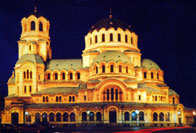
St. Alexander Nevski cathedral
|
You are a guest of an ancient city, whose history began some 9000 years ago. Numerous Neolithic villages have been discovered in the area, while a chalcolithic settlement has been recently discovered in the very centre of modern Sofia. Through the centuries, many peoples have inhabited it axnd added to its rich and diverse history. Many times the city has flourished and competed with Rome and Constantinople, Venice and Dubrovnik. Throughout its history flames and disasters have devastated everything, yet again and again the city has risen from the ruins. |
| |
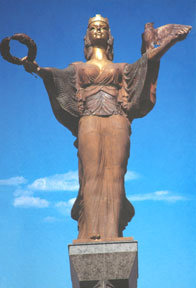
The statue of Sophia – God’s great wisdom – one of city’s symbols
|
Sofia lies in the heart of the Balkan peninsula and has always been a crossing point of main roads from Western Europe to the Bosphorus and from Danube to the Aegean Sea. The Vitosha mountain dominates in the cityscape and numerous springs with mineral water have attracted people over the centuries. Sofia had several names in the past, including Serdica, Triadica, Sredec. The Thracian tribe Serdi were the first to give their name to the city. In the beginning of the 2nd century AD the Roman emperor Marc Ulpius Trajan turned the settlement into a city of strategic importance and gave it the name Ulpia Serdica
The city flourished under Emperor Constantine the Great (306-337). He used to say, "Serdica is my Rome".
After the adoption of Christianity, many churches were built. Sofia became a center for religion. That is why the famous Serdica oecumenical council took place in the city in 343 with participation of 170 bishops from all parts of the Roman Empire. It is supposed that the council was held in the basilica, whose ruins were excavated near the Southern park of the present city.
In the 4th-7th centuries AD the city was demolished several times by invaders. It flourished again for the last time during its Roman period under emperor Justinian (527-565).
|
| |
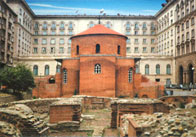
St. George rotunda
|
After the Hun invasion of 441, the Byzantines rebuilt the city. They called it Triadica. In 809 the army of Khan Krum put an end to the first Byzantine period of Sofia and the city was included within the Bulgarian state. The Slavs gave it the name Sredec. It played a key role in the First Bulgarian State. Then the Byzantines retook Sredec and dominated here in 11th-12th centuries. At the end of the 12th century, the Bulgarians returned and Sredec became a major trading centre of the Second Bulgarian State.
The Turks captured Sofia in 1382. In the beginning of the 16th century they made it the administrative centre of all of the European territories of the Ottoman Empire. In the middle of the 18th century the city began to decline during feudal unrest.
|
| |
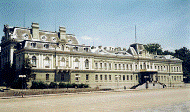
The former royal palace (today
National Art Gallery and National Ethnographic Museum)
|
After the Liberation (1878), with the establishment of the Third Bulgarian State in 1879, Sofia once again became the capital of Bulgaria. Since then the city is the most important political, economic and cultural centre of the country. Rapidly the city's image changed from Oriental to European. The motto of Sofia on its coat of arms says, "It grows but doesn’t age". |
| |
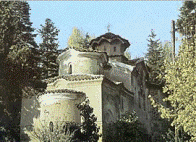
The Boyana church (in UNESCO’s list
of the world cultural heritage)
|
Today many streets, buildings, parks, and even whole neighbourhoods have preserved the architectural style from the turn of the 19th-20th centuries. In spite of the heavy demolitions and irreparable damages from the air-raids during the Second World War, there are still many archaeological sites in Sofia, which display the city's diverse history - the castle gates and towers of Serdica, public buildings and streets thousands of years old. A large part of the ancient city is underneath its modern buildings. |
| |
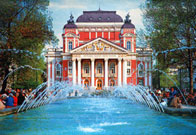
National Theatre "Ivan Vazov"
|
There are numerous museums and galleries worth visiting in the city; among them the National Museum of History, National Archaeological Museum, National Ethnographic Museum, National Art Gallery, etc.
Since ancient times the city has been famous for its abundance of cold and thermal mineral water springs. The water is still available today and is praised for its numerous qualities. Springs may be found in the city centre, as well as in the neighbourhoods.
|
| |
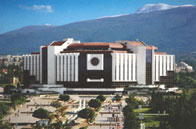
National Palace of Culture
|
Some geographical data about Sofia:
Latitude: 42042’ N
Longitude: 23023’ E
Average altitude: 550 m a.s.l.
Climate: moderate continental
Average temperature in winter: -2.30C
Average temperature in summer: 20.10C
Average annual temperature: 10.20C
Average annual precipitation: 630 mm
Population: 1.2 million
|
| |
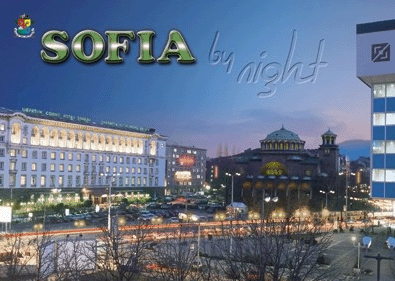
Sveta Nedelya square
|
| |
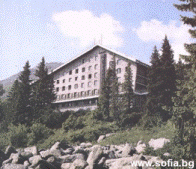
Hotel "Prostor" in Vitosha
|
Vitosha mountain
Sofia lies at the foot of the Vitosha mountain. The Austrian geologist and traveller Ferdinand von Hochstaetter wrote in 1869 that the city and the mountain are as inseparable as Naples and Vesuvius or Cape town and Table mountain. It takes only about half an hour drive to get from the city centre to the mountain. Vitosha is the cradle (1895) of organised tourism in Bulgaria. On 27 October 1934, a big part of Vitosha Mt. was declared as a national park - the first one in Bulgaria and the Balkan peninsula.In 2000 it was designated as a nature park.
|
| |
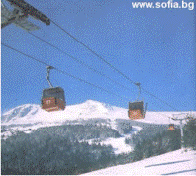
A view in Vitosha
|
The park’s territory has been changed several times and today it is almost 27,000 ha. The afforested area covers 60% of the park.
There are over 1800 invertebrate species, 10 amphibians and 12 reptiles. Over 200 bird species inhabit the territory and more than 160 of them nest there. There are about 50 species of mammals.
About 1500 higher plants grow on Vistosha mountain, representing half of the Bulgarian flora, including nearly 40% of native woody plants. Relict, protected and endemic species are of particular interest.
Due to its well developed infrastructure Vitosha is a famous centre for summer and winter tourism and winter sports.
|
| |
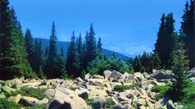
Vitosha stone river
|
There are two reserves in the nature park at Vitosha Mt. "Bistrishko branishte" (1062 ha) was established to preserve the primary Norway spruce and sub-alpine belt ecosystems. In 1977 the reserve was included in UNESCO’s world network of biosphere reserves. Forests cover about 50% of the reserve territory. The average tree age is 100-120 years. The other reserve – "Torfeno branishte" (783 ha) – preserves peat areas in the high-mountain belt. The depth of the peat cover is from 60 cm to 2 m and is from 1000 to 1500 years.
The longest cave in Bulgaria, Duhlata (17 km), is also situated in Vitosha Mt. It is considered one of the most beautiful caves in Bulgaria and has been named a natural landmark.
|
CONFERENCE VENUE
The conference will be held in park-hotel "Moskva" ***.
Location: The hotel is located next to the largest park area in Sofia. It is easily accessed from the airport – in some 15-20 minutes by public transport (bus Nr.84) or taxi. There is a direct bus route (Nr.413) to the central railway and bus stations (about 20 minutes journey time). Tram Nr.18 goes straight to the city centre (15-20 minutes).
Facilities: The hotel has 179 standard, renovated and business rooms and 12 apartments. Currency exchange, internet access, laundry and ironing, taxi services and information editions about entertainments and cultural events are provided. Hotel guests can make their choice between 3 restaurants ("Panorama", "Moskva" and winter garden), 4 bars and confectionaries, fitness centre with sauna, solarium and professional massage and a business centre with all facilities. The hotel has good experience and traditions in organising conferences, seminars, symposia, training activities and presentations. It offers 8 conference halls with various capacities and full technical equipment. For information about the room prices, go to the link "Accommodation" or visit the hotel website.
Address:
Park-hotel "Moskva"
Nezabravka Str., 25
1113 Sofia
Bulgaria
Tel.: +359 2 971-10-24
Fax: +359 2 963-20-41
E-mail: marketing@parkhotelmoskva.net
Internet: www.parkhotelmoskva.net
|